
Moving to a new home in Canada is one of the most significant transitions a household goes through. Whether you are relocating across the street in Toronto or across provinces from Vancouver to Calgary, the physical and logistical demands of a residential move can feel overwhelming if the preparation is not handled properly. The good news is that a structured, step-by-step approach to pre-move home preparation removes most of that stress before it starts.
At Moving ASAP, we have worked with thousands of Canadian families and individuals who needed fast, reliable moving support. One of the most common things we hear after a move is: ‘I wish I had started preparing sooner.’ This guide gives you everything you need to prepare your home before moving day, from weeks in advance down to the final hours before the truck arrives.
At a Glance: Moving Preparation Timeline
| Timeframe | Key Tasks | Priority Level |
| 6 to 8 Weeks Out | Declutter, book movers, gather supplies | High |
| 4 to 5 Weeks Out | Begin packing non-essentials, notify utilities | High |
| 2 to 3 Weeks Out | Pack room by room, address change, confirm booking | Medium to High |
| 1 Week Out | Pack essentials box, clean rooms as emptied | High |
| Moving Day | Final walkthrough, supervise loading, hand over keys | Critical |

Why Preparing Your Home Early Makes a Real Difference
Think about two neighbours in Mississauga who both moved in the same month. The first family started planning six weeks before their move date. They sorted every room, booked a moving company, arranged childcare for moving day, and had everything labelled and stacked by the door two days early. The second family waited until the week before. They were still sorting through closets the night before the truck arrived, had no packing materials, and ended up paying for extra hours of labour.
The difference in those two experiences is entirely about preparation. Pre-move home preparation is not just about packing boxes. It covers home inspection tasks, inventory management, room-by-room sorting, utility transfers, cleaning duties, and the coordination of moving logistics. When each of these areas receives attention ahead of time, moving day becomes a manageable, even smooth, event.
Step One: Declutter and Reduce What You Own
Why Decluttering Before a Move Saves Time and Money
Every extra item you move adds weight, takes up truck space, and costs money. A standard two-bedroom apartment in Ottawa can easily accumulate years of unused belongings that quietly take up closet space, fill storage areas, and sit untouched in drawers. Before you pack a single box, go through every area of your home with a clear goal: reduce what you own.
Professional organizers and experienced movers consistently note that most households can reduce their moving load by 20 to 30 percent through careful pre-move decluttering. That translates directly into fewer boxes, less packing time, and often a lower final bill from your moving company.
Sorting System for Effective Decluttering
Use a four-category system as you go room by room:
- Keep: Items you use regularly and will use in your new home
- Donate: Items in good condition that local charities or shelters in cities like Hamilton or Edmonton would accept
- Sell: Items with resale value that you can list online or sell at a garage sale
- Discard: Broken, expired, or irreparable items that cannot be reused
The donation category is particularly useful for Canadian movers. Organizations such as local Habitat for Humanity ReStores, food banks, and community shelters accept gently used furniture, clothing, and household items. Donating before a move also supports your local community while reducing your load.
Step Two: Create a Complete Home Inventory
Documenting Your Belongings Before the Move
A home inventory serves multiple purposes before and during a move. It helps you keep track of what is being packed, supports insurance claims if anything is damaged or lost in transit, and gives your moving team a clear picture of what needs to be transported.
Walk through every room with a phone camera or a notebook and record the items you plan to move. Note the condition of high-value items such as electronics, art, antiques, and appliances. If you are renting in cities like Calgary or Montreal, your inventory also protects your security deposit by documenting the condition of the home before you leave.
What a Good Home Inventory Includes
- Room-by-room item list with brief condition notes
- Photos or short video walkthroughs of each space
- Serial numbers and estimated values for electronics and appliances
- A list of items requiring special handling such as fragile artwork, pianos, or antique furniture
At Moving ASAP, we recommend sharing a copy of your inventory with your moving coordinator before moving day. This allows the team to arrive with the right equipment and enough time allocated for specialty items.
Step Three: Gather Packing Supplies and Materials
The Right Packing Materials for a Canadian Move
Using the correct packing materials is one of the most overlooked parts of preparing a home before moving day. Many people assume that any box and a roll of tape will do the job. In practice, the wrong materials lead to crushed boxes, broken items, and damaged furniture.
For a typical three-bedroom home in suburban British Columbia or Ontario, you will generally need:
- Small, medium, and large moving boxes in varied quantities
- Heavy-duty packing tape and a tape gun
- Bubble wrap and packing paper for fragile items
- Mattress covers and furniture pads or blankets
- Wardrobe boxes for hanging clothing
- Stretch wrap or plastic wrap for protecting upholstered furniture
- Permanent markers and colour-coded labels for room identification
Avoid using garbage bags for clothing or linens as a shortcut. While this seems efficient, bags tear easily and offer zero protection against moisture, which is particularly relevant during Canadian winter moves when moisture and cold can affect fabrics and materials.
Step Four: Pack Room by Room With a Strategy
Systematic Packing Reduces Chaos on Moving Day
Random packing creates confusion, delays, and broken items. The most effective approach is to pack one room at a time, complete it fully before moving to the next, and label every box with both its contents and its destination room in the new home.
Suggested Packing Order
Begin with the rooms and items you use least frequently and work toward the areas you use every day.
- Storage rooms, garages, and basements first
- Guest rooms and rarely used spaces next
- Living room decor, books, and non-essential items
- Kitchen non-essentials such as specialty cookware and seasonal items
- Bedrooms, leaving daily clothing and bedding until last
- Bathrooms, kitchen essentials, and personal care items last
Packing Heavy Items Correctly
Heavy items such as books, tools, and canned goods should go in small boxes. Large boxes are designed for lighter, bulkier items like pillows, linens, and soft toys. Mixing heavy items into large boxes creates boxes that are dangerous to lift and more likely to split at the bottom.
Compare this to how a professional moving crew handles a library. Each box holds a manageable number of books, is sealed tightly, and is stacked in the truck in a way that distributes weight evenly. Following this method at home produces the same result: safer boxes, easier loading, and fewer accidents.
Step Five: Handle Utilities, Address Changes, and Service Transfers
Utility and Service Management Before Your Move Date
One of the most practical parts of preparing your home before moving day in Canada involves managing the transfer or cancellation of utilities and services. Failing to handle this properly leads to billing issues, service gaps at your new home, and sometimes difficult conversations with providers after the fact.
Key Services to Contact Before Moving Day
| Service Type | Action Required | Timeline |
| Electricity and Gas | Transfer or cancel and set up at new address | 2 to 4 weeks before |
| Internet and Cable | Schedule disconnection and new installation | 2 to 3 weeks before |
| Water and Waste | Notify municipal services of move-out date | 2 weeks before |
| Canada Post | Set up mail forwarding to new address | 1 to 2 weeks before |
| CRA and Government | Update address for tax and benefit records | As soon as possible |
| Financial Institutions | Update address for banking and credit accounts | 1 to 2 weeks before |
In Canada, Canada Post offers a mail redirection service that forwards mail from your old address to your new one for a set period. This gives you a safety net while you update your address across all accounts and subscriptions. It is a simple, affordable step that prevents important correspondence from going missing during the transition.
Step Six: Prepare Your Home for Handover
Cleaning and Condition Obligations Before Leaving
Whether you own your home or rent it, the condition in which you leave the property matters. For renters across Canada, most provincial tenancy agreements require that the property be returned in the same condition as when you moved in, reasonable wear and tear aside. Failing to meet this standard can cost you your security deposit.
For homeowners, a clean, well-presented home supports a positive relationship with the incoming buyer and may be a condition of your sale agreement. In both cases, cleaning as you pack is more efficient than attempting a complete clean on moving day when you are already tired and pressed for time.
Room-by-Room Pre-Move Cleaning Checklist
- Kitchen: Clean the oven, stovetop, refrigerator interior, and all cabinets
- Bathrooms: Scrub tiles, clean grout, descale fixtures, and sanitize all surfaces
- Living areas: Vacuum carpets or mop floors, wipe down baseboards, clean windows
- Bedrooms: Remove all items from closets, patch any wall holes, clean ceiling fans
- Garage and storage: Clear all items, sweep, remove any stains from the floor
- Outdoors: Remove personal items, tidy garden areas if applicable
Step Seven: Prepare Your New Home Before You Arrive
What to Arrange at the New Address in Advance
Preparing your home before moving day also includes getting the new home ready to receive your belongings. Arriving at a new address that has not been cleaned, inspected, or set up for incoming boxes adds unnecessary complication to an already busy day.
If possible, visit your new home a week before the move to complete the following tasks:
- Deep clean the entire space before furniture arrives
- Check that all utilities are active and functioning
- Measure doorways and rooms to confirm furniture will fit
- Identify where large items such as sofas, beds, and appliances will be placed
- Install any shelf liners, hooks, or minor fixtures before boxes arrive
- Change the locks if purchasing a resale home
A family moving from Brampton to a new home in Oakville, for example, might visit the new property on a Saturday, a full week before their Wednesday move date. During that visit, they clean the kitchen cabinets, install bathroom hardware, test all light switches and outlets, and decide on a furniture layout. When moving day arrives, the truck can be unloaded efficiently because every team member knows exactly where each item goes.
Step Eight: Pack an Essentials Box for Moving Day
What Goes in Your Moving Day Survival Kit
An essentials box, sometimes called a first-night box, is the single most practical thing you can prepare before moving day. This box stays with you rather than going on the truck and contains everything you will need during the first 24 hours in your new home before the rest of your belongings are unpacked and organized.
Recommended Essentials Box Contents
- Phone chargers and portable power bank
- Medications and first aid basics
- Toilet paper, hand soap, and paper towels
- A change of clothes for each household member
- Snacks and water bottles
- Basic kitchen items: kettle, mugs, instant coffee or tea
- Important documents: lease agreement, insurance papers, identification
- Children’s comfort items or toys if applicable
- Bedding essentials: one set of sheets and pillowcases per bed
This box eliminates the frantic search through dozens of unlabelled containers for a toothbrush or a phone charger at 11 PM on moving night. It is a small investment of time that delivers significant comfort during the most hectic part of a move.
Step Nine: Coordinate Logistics With Your Moving Company
What to Communicate to Your Movers Before the Day
If you have booked professional movers such as Moving ASAP, the days leading up to moving day are the time to confirm and communicate key logistical details. Surprises on moving day lead to delays, extra charges, and frustration for everyone involved.
Information to Share With Your Moving Team
- Confirmed pickup time and arrival window
- Access details for both properties including parking restrictions, elevator bookings, and gate codes
- A list of any items that require disassembly such as large bed frames or wall-mounted shelving
- Any items that will not be moving with the truck
- Special handling instructions for fragile, oversized, or high-value items
- Contact numbers for the day in case of questions or delays
In high-rise buildings across major Canadian cities like Toronto and Vancouver, elevator reservations for moving are often required and must be booked through the building management office well in advance. Missing this detail can delay your entire move by several hours while you wait for elevator access. Confirming these logistics ahead of time avoids that entirely.
Step Ten: Complete a Final Walkthrough of Your Home
The Last Check Before You Hand Over the Keys
Before the moving truck drives away and before you hand over keys to a landlord or new owner, complete a thorough final walkthrough of your home. This is your last opportunity to catch anything that was left behind, confirm the property is in acceptable condition, and document anything that needs attention.
Go through every room in the home systematically, including storage spaces, closets, and outdoor areas. Check behind doors, inside cabinets, and in spots that are easy to overlook such as under beds, behind appliances, and in the back of garage shelving. Take dated photos of the property as you complete the walkthrough. This creates a clear record of the home’s condition at the time of handover.
Final Walkthrough Checklist
- All personal belongings removed from every room and storage area
- All windows and doors closed and locked
- All lights turned off and utilities in the agreed-upon status
- Appliances cleaned and in the condition specified in your agreement
- Any keys, fobs, or garage remotes collected and ready for handover
- Photographic documentation of every room completed
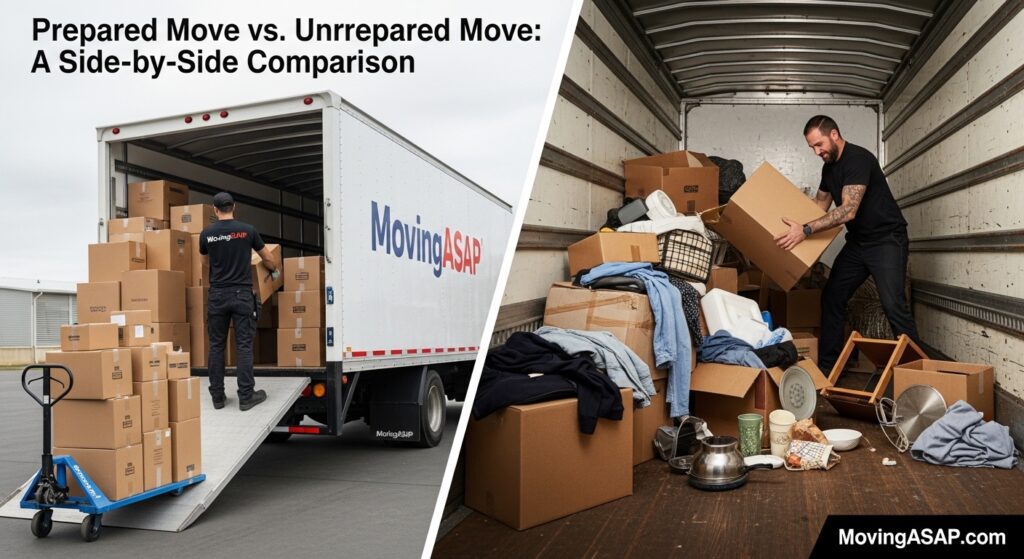
Prepared Move vs. Unprepared Move: A Side-by-Side Comparison
| Factor | Prepared Move | Unprepared Move |
| Packing Time | Spread over several weeks, manageable | Rushed and stressful in final days |
| Moving Costs | Lower due to fewer boxes and efficient time | Higher due to delays and extra hours |
| Damage Rate | Lower with proper materials and labelling | Higher due to rushed, unprotected packing |
| Utility Transfers | Smooth and confirmed in advance | Gaps in service, billing errors |
| Moving Day Stress | Controlled and organized | Chaotic and unpredictable |
| Final Walkthrough | Thorough and documented | Rushed or skipped entirely |
Special Considerations for Common Moving Challenges in Canada
Moving During Winter in Canadian Climates
Winter moves are common in Canada and come with their own set of challenges. Snow, ice, and below-freezing temperatures affect everything from how boxes hold up to how safely a moving truck can be loaded and unloaded. If your move falls between November and March, factor these conditions into your preparation.
- Protect hardwood floors and carpets at both properties with floor runners or protective coverings
- Wrap electronics and wooden furniture in blankets to protect them from cold and moisture
- Keep pathways at both properties clear of ice and snow before the truck arrives
- Plan for a longer moving window since cold weather slows down loading and unloading
Moving With Children and Pets
Children and pets add emotional and logistical complexity to any home move. Involving children in age-appropriate tasks such as packing their own belongings and labelling their boxes gives them a sense of ownership over the transition. For pets, consider arranging for them to stay with a trusted person or at a boarding facility on moving day to reduce their stress and keep them safe while doors are constantly opening and closing.
Moving Plants and Prohibited Items
Plants require special care during a move, particularly in the cold months. Most moving companies, including Moving ASAP, advise transporting houseplants in your own vehicle rather than on the moving truck. Certain items cannot go on a moving truck at all, including hazardous materials, propane tanks, and certain cleaning chemicals. Review your moving company’s prohibited items list and dispose of or transport these separately before moving day.
Frequently Asked Questions About Preparing Your Home Before Moving Day
How far in advance should I start preparing my home for a move?
For most Canadian households, six to eight weeks is an ideal starting point. This gives you enough time to declutter, gather packing supplies, book professional movers, and manage all the administrative tasks such as utility transfers and address changes without feeling rushed. If you are making a last-minute move, Moving ASAP specializes in fast-turnaround relocations and can support you even with shorter notice.
What is the most important thing to do before moving day?
While every step in this guide matters, creating a detailed moving plan and booking your moving company early are the two highest-impact actions. Everything else, including packing, cleaning, and utility transfers, flows from having a confirmed date and a trusted team in place. Professional movers fill up quickly, especially during peak moving season in Canada, which runs from May through September.
Should I clean my home before or after packing?
Clean as you go. After you pack and remove items from a room, clean that room before moving to the next. This approach spreads the cleaning workload across several weeks, ensures each area is properly addressed, and means that by the time moving day arrives, the majority of your cleaning is already done. Attempting to clean an entire home in one session on the final day is inefficient and exhausting.
Do professional movers in Canada help with packing?
Many professional moving companies in Canada, including Moving ASAP, offer full packing and unpacking services as part of their packages. If you do not have the time or physical capacity to handle packing on your own, this service is worth considering. A professional packing team can pack a standard home significantly faster than most households working independently, and the packing quality is typically higher because teams use professional materials and techniques daily.
What should I do with items I do not want to move?
Items you no longer need have several possible destinations. Gently used items can be donated to local charities, shelters, or community organizations across Canada. Items with resale value can be listed on platforms such as Facebook Marketplace or Kijiji. Broken or non-functional items should be responsibly disposed of through your municipality’s bulk waste pickup service or appropriate recycling channels. Reducing what you move saves money and simplifies the entire process.
How do I protect large furniture pieces during a move?
Large furniture pieces require proper wrapping to prevent scratches, dents, and moisture damage. Use furniture blankets or moving pads to cover sofas, dressers, and wooden pieces. Wrap table legs individually with bubble wrap and secure them with tape. Disassemble large bed frames, shelving units, and dining tables where possible and keep the hardware in a labelled bag taped to the piece it belongs to. At Moving ASAP, our teams are trained in furniture protection and arrive with the necessary pads and materials to handle your belongings safely.
Is it worth hiring professional movers for a local move within Canada?
For most households, yes. Even for short-distance moves within the same city, professional movers bring equipment, experience, and efficiency that most households cannot replicate independently. The risk of personal injury from lifting heavy furniture, the time required to make multiple vehicle trips, and the potential for damage to belongings and property all increase significantly with a self-managed move. Professional movers handle these risks as part of their everyday work. For Canadian families in particular, where moves often involve multi-floor homes, long driveways, or winter conditions, professional assistance delivers real value.
Final Thoughts From Moving ASAP
Knowing how to prepare your home before moving day is not just about having the right boxes or the neatest labels. It is about giving yourself enough time, making thoughtful decisions about what you own, and partnering with the right people to handle the physical work.
At Moving ASAP, we have supported households across Canada through every kind of move, from first-apartment relocations in Halifax to large family home transfers in the Greater Toronto Area. What we consistently see is that the moves that go smoothly are the ones where the homeowner prepared in advance: decluttered before packing, booked early, communicated clearly with the moving team, and arrived at the new property ready to settle in rather than still sorting through chaos.
If you are planning a move anywhere in Canada and want a professional, reliable team behind you, Moving ASAP is ready to help. Whether you need full-service packing and transport or simply a trustworthy crew to handle the heavy lifting, we bring speed, care, and local expertise to every job.
Start your preparation today and give your move the attention it deserves. A well-prepared move is not just less stressful. It is faster, more affordable, and sets the right tone for life in your new home.
