
Moving day in Ontario is already packed with pressure. Whether moving across Oshawa, transferring to North York, relocating within Barrie, or shifting from one end of Toronto to another, the last thing anyone wants is a moving truck stuck in traffic with no legal place to stop and unload. Yet parking for the moving truck is one of the most overlooked parts of the entire relocation process.
Moving ASAP has handled hundreds of residential and commercial moves across Ontario, and the team consistently sees how an unsecured parking spot causes delays, unexpected fines, and added stress. This guide breaks down everything needed to plan parking for the moving truck properly, covering municipal rules, permit logistics, real examples from Ontario streets, and practical steps that protect both the move and the budget.
Quick Reference: Parking Plan for the Moving Truck by Ontario City
| City | Permit Required | Typical Lead Time | Who to Contact |
| Toronto | Yes (most areas) | 2 to 5 business days | City of Toronto 311 |
| Oshawa | Sometimes | 1 to 3 business days | City of Oshawa Parking |
| North York | Yes (urban roads) | 2 to 4 business days | Toronto 311 (North York) |
| Barrie | Rarely required | 1 to 2 business days | City of Barrie Parking Dept. |
Why Planning Parking for the Moving Truck Matters More Than Most People Think
Most people assume that parking a large moving truck is simply a matter of pulling up to the curb. In reality, Ontario municipalities have specific rules about commercial vehicle parking, temporary road occupancy, and residential street use that can result in fines starting at $100 and going well above $500 for larger violations.
Consider a real scenario: A family in the Annex neighbourhood of Toronto booked a moving company without securing a parking permit in advance. On moving day, the truck arrived and there was no available space close to the building. The driver parked in a no-stopping zone while unloading, and within forty minutes, the truck received a $150 fine. The delay also meant the movers went into overtime, adding another cost to the final bill. This is not an unusual story. The same situation plays out in North York driveways, Oshawa townhouse complexes, and Barrie condo parking areas regularly.
Planning parking for the moving truck removes this risk entirely. It also speeds up the physical move because the crew does not need to carry furniture long distances from a distant parking spot to the front door.
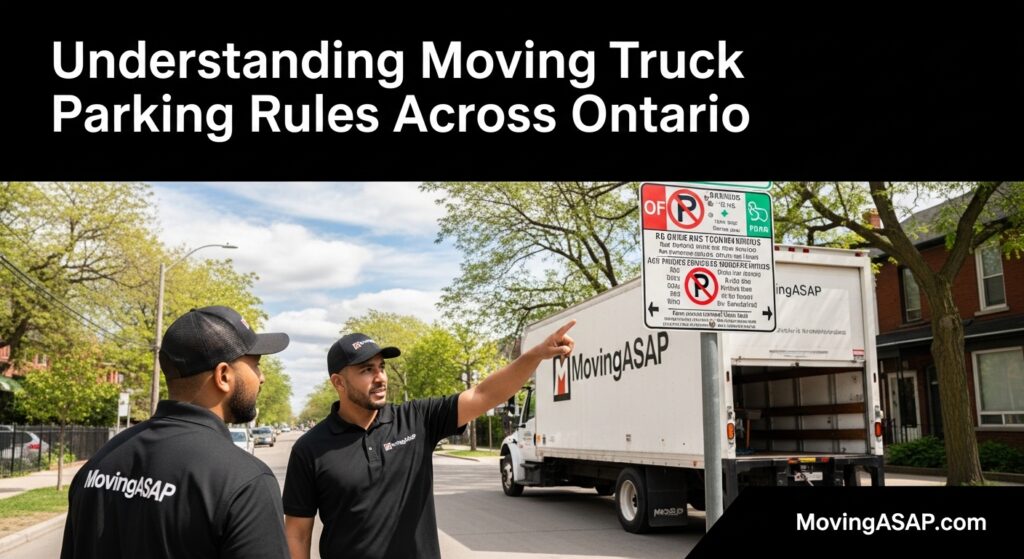
Understanding Moving Truck Parking Rules Across Ontario
Toronto Moving Truck Parking Regulations
Toronto is the most permit-heavy city for moving vehicle parking in Ontario. The city requires a Temporary Encroachment Permit or a No-Parking Permit for commercial vehicles occupying a residential street for extended periods. The permit is typically applied for through the City of Toronto 311 service or through the transportation services portal online.
Applications should be submitted at minimum two to five business days before the move date. In high-density areas such as downtown Toronto, Liberty Village, and the Distillery District, permits may be harder to obtain close to the move date, so earlier applications are strongly recommended. The permit grants the right to temporarily suspend parking on a section of the road so the moving truck has a clear, legal stopping zone directly in front of the property.
North York Moving Vehicle Parking Rules
North York falls within the City of Toronto’s jurisdiction, which means the same permit framework applies. However, North York’s residential streets often have wider lots and more driveway space compared to downtown Toronto, which can reduce the need for a full street permit in some situations.
For properties with long driveways or rear-lane access, the moving truck may be able to use private property for loading and unloading without occupying public road space at all. Always confirm with the building manager or property owner before assuming driveway access is available. Condominiums and apartment buildings in North York often have loading-dock rules requiring advance booking.
Oshawa Moving Truck Parking Considerations
Oshawa has a more relaxed parking enforcement environment compared to downtown Toronto, but that does not mean there are no rules. The City of Oshawa has overnight parking restrictions on most residential streets from November to April, and commercial vehicles left unattended for more than three hours in certain zones can be ticketed.
For most residential moves in Oshawa, a quick call to the city parking department confirms whether a permit is needed. Many single-family home neighbourhoods in Oshawa have wide enough streets and available curb space that a permit is not strictly required, but confirming this in advance is always the safer approach.
Barrie Moving Truck Parking Overview
Barrie is one of the more accommodating cities in Ontario for moving truck parking. Most residential areas in Barrie have sufficient curb space for a standard 26-foot moving truck. However, newer condo developments and townhouse communities near the waterfront or in the south end of the city may have internal road restrictions that limit large vehicle access.
The City of Barrie recommends notifying the parking services department at least two business days before a large vehicle will be occupying a street for an extended period, even if a formal permit is not legally required in that zone.
Step-by-Step Guide to Plan Parking for the Moving Truck
Step 1: Assess the Property Layout Before Moving Day
Before calling any permit office or making any plans, physically assess both the origin and destination properties. This means walking the street at the same time of day the move will happen, noting how many cars are parked, whether there is a fire hydrant zone near the entry, and how close the front door is to the nearest legal parking spot.
Factors to assess at each property include road width, the presence of curb cuts or bus stops, proximity to intersections (vehicles cannot park within a set distance of intersections under Ontario traffic rules), and whether the building has a loading zone or service entrance.
Step 2: Measure the Moving Truck Size Against Available Space
Not all moving trucks are the same size. A studio apartment move may require a 10-foot truck. A four-bedroom home in Oshawa might need a 26-foot truck. The size of the vehicle directly affects how much street space is needed. Standard parking spaces in Ontario are approximately 8 feet wide and 18 feet long, meaning a 26-foot moving truck needs at least two to three standard parking spaces to park safely without blocking traffic.
Moving ASAP provides clear information on truck sizes at the time of booking so clients can plan their street space requirements accordingly. Knowing the truck dimensions ahead of time is a critical part of the permit application process, since most municipalities require the applicant to specify the vehicle length.
Step 3: Contact the Municipality for Permit Requirements
Once the property assessment is complete and the truck size is known, contact the relevant city department. For Toronto and North York, this is the 311 service. For Oshawa, it is the City of Oshawa Parking Enforcement office. For Barrie, it is the City of Barrie Parking Services division.
When making the call or completing the online application, have the following information ready: the exact address of the property, the date and approximate time window of the move, the length of the truck, and the number of parking spaces that need to be temporarily reserved. Some municipalities also ask for the moving company name and contact information.
Step 4: Post the Permit and Notify Neighbours
Once a permit is approved, it typically needs to be posted visibly in the area where parking will be restricted. In Toronto, approved no-parking signs are either provided by the city or can be printed and posted according to city instructions. The permit specifies the date, time window, and vehicle length.
Notifying neighbours is a practical step that goes beyond the legal requirement. Leaving a note on doors of nearby units or speaking to neighbours directly gives them advance notice to move their vehicles. This prevents the situation where the reserved space is still occupied on moving day because a neighbour did not know about the restriction.
Step 5: Confirm Building or Complex Rules for Loading Zones
For apartment buildings, condominiums, and townhouse communities across Toronto, North York, Oshawa, and Barrie, there is often an internal building policy that governs moving truck access. This is completely separate from municipal parking rules and is enforced by property management.
Most condo buildings require booking the service elevator and the loading dock at least 48 to 72 hours in advance. Some buildings in downtown Toronto require a damage deposit to use the loading area. Failing to book these in advance means the moving crew may arrive to find the loading dock occupied by another move, forcing a long wait or an unplanned change to the access route.
Comparing Parking Challenges: Downtown Toronto vs. Suburban Oshawa
To make the comparison concrete, consider two different moving scenarios that Moving ASAP regularly handles.
Scenario A: Downtown Toronto Condo Move
A client in a high-rise condominium near King Street West in downtown Toronto books a move for a Saturday morning in August. The building has one loading dock that is shared by all units. The building management requires 72-hour advance notice to book the dock, and the dock is only available in two-hour windows. The street outside has heavy Saturday traffic and no available curb space without a permit.
In this case, the parking plan involves three layers: booking the loading dock through building management, applying for a street no-parking permit through Toronto 311, and coordinating with Moving ASAP on truck arrival time to match the dock window. When all three are aligned, the move is completed efficiently. When even one is missed, the entire timeline breaks down.
Scenario B: Suburban Oshawa Single-Family Home Move
A client in a detached home in a quiet Oshawa neighbourhood books a move for a weekday morning in October. The street is wide, there is no overnight parking restriction at that time of year, and the driveway is large enough for the truck to partially pull off the road. There are no neighbours immediately adjacent who park on the street.
In this scenario, a formal permit is unlikely to be required. However, the Moving ASAP team still confirms with the client whether there are any utility work or road closures planned that week, and verifies the driveway dimensions against the truck size. The planning is simpler but the verification step is just as important.
Common Parking Mistakes That Delay Moves in Ontario
| Common Mistake | Consequence | Prevention |
| No permit applied for | Fines, truck forced to move mid-unload | Apply 5 days in advance |
| Wrong truck size estimated | Not enough street space reserved | Confirm truck size at booking |
| Loading dock not booked | Wait time, overtime charges | Book 72 hours ahead |
| Neighbours not notified | Reserved space still occupied | Post notice 48 hours before |
| Fire hydrant zone missed | Immediate tow or ticket | Walk the street beforehand |
| Intersection proximity rule ignored | Ticket or forced relocation | Check Ontario traffic regulations |
Parking for the Moving Truck at Condo Buildings Across Ontario
Condominium buildings represent a unique challenge for moving truck parking across Toronto, North York, Oshawa, and Barrie. Unlike single-family homes, condos have shared infrastructure governed by a corporation or property management company. The rules can vary significantly from one building to the next.
Loading Dock Reservation Process
Most condo buildings with loading docks operate on a first-come, first-served booking system. The property management office or the building concierge handles these bookings. Some buildings use an online portal. Moving ASAP always recommends contacting the building before the move date is confirmed so the dock availability can be factored into the scheduling.
Freight Elevator Booking
Alongside the loading dock, the freight elevator must usually be reserved separately. In many Toronto high-rise buildings, the freight elevator is in high demand on weekends and at the beginning and end of each month. A mid-month weekday move often has more flexibility for booking both the dock and the elevator, which is worth considering when setting the move date.
Parking Garage Limitations
Some buildings allow the moving truck to enter the underground parking garage for loading. Before assuming this is an option, confirm the clearance height at the garage entrance. Most parking garages in Ontario have height restrictions between 6.5 and 7.5 feet. Standard moving trucks are significantly taller than this, meaning garage access is rarely possible without a low-profile vehicle.
Seasonal Factors That Affect Moving Truck Parking in Ontario
Ontario weather plays a direct role in the logistics of parking for the moving truck, particularly for moves in the winter months between November and April.
Winter Parking Restrictions
Most Ontario municipalities enforce seasonal overnight parking bans on residential streets during winter. The purpose is to allow snow plows to clear roads without obstruction. Oshawa, Barrie, Toronto, and North York all have versions of this restriction. During these periods, a moving truck that arrives early in the morning for a residential move cannot be left on the street overnight before the move date.
Winter moves also require more planning around ice and snow conditions. A clear path from the truck to the front door is essential for the safety of the moving crew and the protection of furniture. Clients should clear snow and ice from driveways and walkways before the team arrives.
Summer Moving Season Congestion
Summer is the peak moving season in Ontario. Demand for parking permits in Toronto and North York is highest between May and September. Applications submitted close to the move date during peak season are more likely to face processing delays. Moving ASAP advises clients planning summer moves to begin the permit application process at least seven to ten business days in advance rather than the standard two to five.
Street congestion is also higher during summer, meaning a truck that is parked further from the building due to limited space will slow down the move more significantly than in off-peak months.
How Moving ASAP Helps Clients Plan Parking for the Moving Truck
Moving ASAP is a full-service moving company operating across Oshawa, North York, Barrie, and Toronto. Part of the service offering includes parking logistics support, which means clients are not left to navigate municipal permit systems on their own.
When a client books with Moving ASAP, the team reviews the origin and destination addresses and flags any known parking challenges. For moves in downtown Toronto or North York condo buildings, the team proactively advises on permit timelines and building booking requirements. For suburban moves in Oshawa or Barrie, the team confirms street access and truck clearance as standard practice.
This approach eliminates the most common cause of moving day delays in Ontario: a truck that has no place to legally park. It also removes the financial risk of receiving a parking fine that was entirely preventable with proper planning.
Practical Tips for Planning Moving Truck Parking in Ontario
- Apply for a parking permit as early as possible, ideally one to two weeks before the move date.
- Confirm the truck size with the moving company before submitting any permit application.
- Walk both the origin and destination streets to identify fire hydrant zones, bus stops, and intersection setbacks.
- Contact building management for any condo or apartment move to reserve the loading dock and freight elevator.
- Notify immediate neighbours at least two days before the move to ensure they clear the reserved space.
- Check for any planned road work or construction that could affect truck access on the move date.
- For winter moves in Oshawa, Barrie, Toronto, and North York, verify that overnight parking restrictions do not affect the truck arrival time.
- Keep a copy of the approved permit visible from the street on the day of the move.
- Confirm that the truck driver has the property address, contact number, and building access instructions before arrival.
- Book elevator and dock access confirmation in writing from the building management office.
Moving Truck Parking at Commercial Properties in Ontario
Commercial moves in Toronto, Oshawa, North York, and Barrie add another layer of parking complexity. Office buildings, retail spaces, and industrial units often have shared loading bays, strict delivery window policies, and building security requirements for large vehicles.
For commercial relocations, Moving ASAP coordinates with the facilities or property management team at both the origin and destination sites. This includes confirming loading bay dimensions, truck height restrictions, and permitted access hours. Many commercial buildings in downtown Toronto limit large vehicle access to early morning windows before 8 a.m. or after 6 p.m. to minimize disruption to building tenants.
Failing to account for commercial property rules can result in the truck being turned away entirely, forcing a rescheduled move at additional cost. The planning effort required for a commercial move is always more involved than a residential one, and parking logistics are a core part of that planning.
Frequently Asked Questions About Planning Parking for the Moving Truck
Do I always need a parking permit for a moving truck in Toronto?
Not in every case, but in most urban Toronto and North York locations, a temporary no-parking permit is required to legally reserve street space for a commercial vehicle. The safest approach is to contact Toronto 311 and ask specifically about the address in question. Assuming no permit is needed without verifying is one of the most common mistakes made during urban moves.
How much does a moving truck parking permit cost in Ontario?
Permit costs vary by municipality. In Toronto, temporary no-parking signs are typically processed through the city, and fees are generally between $30 and $100 depending on the number of spaces and duration. Oshawa and Barrie may not charge a fee for informal notifications but could have processing fees for formal encroachment permits. Always confirm the current fee schedule directly with the city department when applying.
What happens if my moving truck gets a parking ticket?
If the truck receives a ticket during the move, the fine is typically the responsibility of the moving company if the truck is in their name, though this depends on the contract terms. Moving ASAP secures parking information in advance to prevent this situation. If a ticket is issued despite a valid permit being displayed, it can usually be disputed with the permit documentation as evidence.
Can the moving truck park in my driveway?
Yes, in most cases the truck can use a private driveway, provided the driveway is long enough and wide enough to accommodate the vehicle without blocking the public sidewalk. A truck extending over the sidewalk can result in an obstruction violation under Ontario municipal bylaws. Moving ASAP confirms driveway dimensions against truck size before arriving.
How far in advance should I plan parking for the moving truck?
For Toronto and North York, at least five to seven business days is recommended for permit applications. During peak summer months, ten business days is safer. For Oshawa and Barrie, two to three business days is usually sufficient for residential moves. For commercial moves or condo building moves, begin the process two weeks in advance to account for building management approval timelines.
What if the reserved parking space is occupied on moving day?
If a valid permit is posted and the space is still occupied by another vehicle, contact the local parking enforcement authority immediately. In Toronto, this is done through 311. Parking enforcement can dispatch an officer to ticket or tow the offending vehicle. Having a clear photo of the posted permit and the occupied space helps expedite the response. This is another reason why notifying neighbours in advance is strongly recommended.
Does Moving ASAP handle parking permits on behalf of clients?
Moving ASAP provides detailed guidance on parking requirements for every move and assists clients in understanding the permit process. The company advises on timing, documentation, and municipal contacts. For clients who prefer full-service coordination, the Moving ASAP team works through the logistics as part of the move planning consultation.
Are there different rules for apartment buildings vs. houses in Ontario?
Yes, significantly different rules apply. Single-family homes typically only need to contend with municipal street parking regulations. Apartment buildings and condominiums have additional internal policies set by property management that govern loading dock access, freight elevator booking, damage deposits, and permitted moving hours. Both sets of rules must be addressed simultaneously for a condo move to go smoothly.
Plan Parking for the Moving Truck Early and Move With Confidence
The effort required to plan parking for the moving truck is small compared to the disruption caused by ignoring it. A single parking permit application, a phone call to the building management, a note left on a neighbour’s door – these small actions eliminate the biggest logistical risks of moving day in Ontario.
Across Oshawa, North York, Barrie, and Toronto, municipal rules exist for good reasons. They manage road safety, protect shared public infrastructure, and ensure that residential streets function properly even when large vehicles need to use them temporarily. Working within these rules rather than around them is both the legal and the practical choice.
Moving ASAP is built on the belief that a well-planned move is a stress-free move. Parking is one of the most concrete and controllable parts of that plan. When the truck has a legal, clear, and accessible spot directly in front of the property, everything else about the move becomes faster, safer, and more efficient.
